Related:
Anyon,
Atom,
Boltzmann's constant,
Bose–Einstein statistics,
Bose-Einstein condensate,
Bose-Einstein statistics,
Boson,
Braid statistics,
Chemistry,
Commutator,
Cyclic group,
Determinant,
Dirac delta function,
Eigenvalue,
Eigenvector,
Electric charge,
Electron,
Electron shell,
Elementary charge,
Elementary particle,
Energy,
Entropy (thermodynamics),
Extensive variable,
Factorization,
Fermi–Dirac statistics,
Fermi-Dirac statistics,
Fermi gas,
Fermion,
Fock space,
Fractional statistics,
Gibbs paradox,
Gluon,
Hamiltonian (quantum mechanics),
Heisenberg picture,
Helium-3,
Helium-4,
Hermitian operator,
Hilbert space,
Homotopic,
Homotopy,
Homotopy class,
Ideal gas,
Identical particles,
Laser,
MOSFET,
Mass,
Mathematical formulation of quantum mechanics,
Matrix (mathematics),
Matter,
Maxwell–Boltzmann statistics,
Molecule,
Neutrino,
Neutron,
Normalizing constant,
Parastatistics,
Particle in a box,
Particle statistics,
Partition function (statistical mechanics),
Pauli exclusion principle,
Permutation,
Phonon,
Photon,
Plekton,
Position (vector),
Proton,
Quantum Hall effect,
Quantum entanglement,
Quantum field theory,
Quantum mechanics,
Quantum state,
Quark,
Quasi-set theory,
Slater determinant,
Spin-statistics theorem,
Spin (physics),
Statistical mechanics,
Superfluid,
Symmetric group,
Temperature,
Tensor product,
Thermodynamics,
Unitarity,
Unitary operator,
Universal covering space,
Volume,
Wave vector,
Wavefunction,
Willard Gibbs,
Identical particles, or indistinguishable particles, are particles that cannot be distinguished from one another, even in principle. Species of identical particles include elementary particles such as electrons, as well as composite particles such as atoms and molecules which are in precisely the same quantum state.
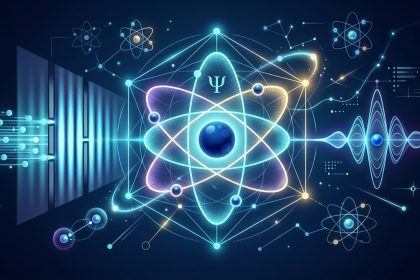
The atom is a basic unit of matter consisting of a dense, central nucleus surrounded by a cloud of negatively charged electrons. The atomic nucleus contains a mix of positively charged protons and electrically neutral neutrons (except in the case of hydrogen-1, which is the only stable nuclide with no neutron). The electrons of an atom are bound to the nucleus by the electromagnetic force. Likewise, a group of atoms can remain bound to each other, forming a molecule. An atom containing an equal number of protons and electrons is electrically neutral, otherwise it has a positive or negative charge and is an ion. An atom is classified according to the number of protons and neutrons in its nucleus: the number of protons determines the chemical element, and the number of neutrons determine the isotope of the element.[1]
The Boltzmann constant (k or kB) is the physical constant relating energy at the particle level with temperature observed at the bulk level. It is the gas constant R divided by the Avogadro constant NA:
In statistical mechanics, Bose–Einstein statistics (or more colloquially B–E statistics) determines the statistical distribution of identical indistinguishable bosons over the energy states in thermal equilibrium.A Bose–Einstein condensate (BEC) is a state of matter of a dilute gas of weakly interacting bosons confined in an external potential and cooled to temperatures very near to absolute zero (0 K, −273.15 °C, or −459.67 °F). Under such conditions, a large fraction of the bosons occupy the lowest quantum state of the external potential, and all wave functions overlap each other, at which point quantum effects become apparent on a macroscopic scale.
In statistical mechanics, Bose–Einstein statistics (or more colloquially B–E statistics) determines the statistical distribution of identical indistinguishable bosons over the energy states in thermal equilibrium.In particle physics, bosons are subatomic particles which obey Bose–Einstein statistics; they are named after Satyendra Nath Bose and Albert Einstein. In contrast to fermions, which obey Fermi-Dirac statistics, several bosons can occupy the same quantum state. Thus, bosons with the same energy can occupy the same place in space. Therefore bosons are often force carrier particles while fermions are usually associated with matter, though in quantum physics the distinction between the two concepts is not clear cut.In mathematics and theoretical physics, braid statistics is a generalization of the statistics of bosons and fermions based on the concept of braid group. A similar notion exists using a loop braid group.