Coordination number

The coordination number of an atom in a molecule or crystal is the integer number of its nearest neighbours. This number is determined somewhat differently for molecules and for crystals. In chemistry the emphasis is on molecules (or ions) with defined bonding structures, and the coordination number of an atom is determined by simply counting the other atoms to which it is bonded (by either single or multiple bonds).

Alfred Werner (December 12, 1866 - November 15, 1919) was a Swiss chemist who was a professor at the University of Zurich. He won the Nobel Prize in Chemistry in 1913 for proposing the octahedral configuration of transition metal complexes. Werner developed the basis for modern coordination chemistry. He was the first inorganic chemist to win the Nobel prize, and the only one prior to 1973.

Allotropy (Gr. ἄλλος (allos), "other", and τρόπος (tropos), "manner") or allotropism is a behavior exhibited by certain chemical elements: these elements can exist in two or more different forms, known as allotropes of that element. In each allotrope, the element's atoms are bonded together in a different manner. Allotropes are different structural modifications of an element.[1] Allotropes should not be confused with isomers, which are chemical compounds that share the same molecular formula but have different structural formulae.

Angewandte Chemie is a weekly peer-reviewed scientific journal that covers all aspects of chemistry. Its impact factor was 10.031 in 2007, the highest value for a chemistry-specific journal that publishes original research.[1] It is a journal of the German Chemical Society and is published by Wiley-VCH.An ion is an atom or molecule where the total number of electrons is not equal to the total number of protons, giving it a net positive or negative electrical charge. An anion (pronounced /ˈænaɪən/; an-eye-on), from the Greek word ἀνά (ana), meaning 'up', is an ion with more electrons than protons, giving it a net negative charge (since electrons are negatively charged and protons are positively charged). Conversely, a cation (pronounced /ˈkætaɪən/; cat-eye-on), from the Greek word κατά (kata), meaning 'down', is an ion with more protons than electrons.

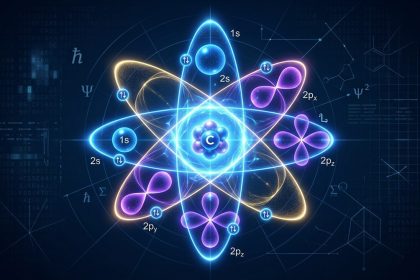
The atom is a basic unit of matter consisting of a dense, central nucleus surrounded by a cloud of negatively charged electrons. The atomic nucleus contains a mix of positively charged protons and electrically neutral neutrons (except in the case of hydrogen-1, which is the only stable nuclide with no neutron). The electrons of an atom are bound to the nucleus by the electromagnetic force. Likewise, a group of atoms can remain bound to each other, forming a molecule. An atom containing an equal number of protons and electrons is electrically neutral, otherwise it has a positive or negative charge and is an ion. An atom is classified according to the number of protons and neutrons in its nucleus: the number of protons determines the chemical element, and the number of neutrons determine the isotope of the element.[1]Denticity refers to the number of atoms in a single ligand that bind to a central metal in a coordination complex. In many cases, only one atom in the ligand binds to the metal, so the denticity equals one, and the ligand is said to be monodentate. Ligands with more than one bonded atom are polydentate or multidentate.
In bidentate or didentate ligands, such as oxalate or ethylenediamine, the ligand binds to the metal at two points. A tridentate binds with three atoms and so on. EDTA is a hexadentate ligand, which forms a strong chelate by binding to a central metal at up to six different points (depending on pH). [1] [2]An ion is an atom or molecule where the total number of electrons is not equal to the total number of protons, giving it a net positive or negative electrical charge. An anion (pronounced /ˈænaɪən/; an-eye-on), from the Greek word ἀνά (ana), meaning 'up', is an ion with more electrons than protons, giving it a net negative charge (since electrons are negatively charged and protons are positively charged). Conversely, a cation (pronounced /ˈkætaɪən/; cat-eye-on), from the Greek word κατά (kata), meaning 'down', is an ion with more protons than electrons.

       Partly based on Coordination number from Wikipedia (licence GFDL, CC-BY-SA 3.0, authors, history, edit this page)