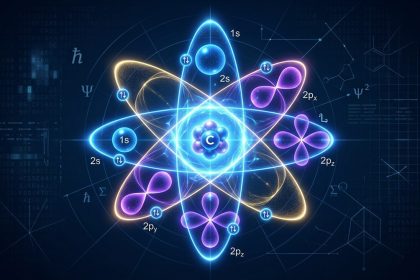
Bohr model

Related:
1913 in science, Action-angle coordinates, Action (physics), Adiabatic invariant, Angular momentum, Antonius Van den Broek, Arnold Sommerfeld, Arthur Erich Haas, Atom, Atomic nucleus, Atomic number, Atomic orbital, Atomic orbitals, Atomic physics, Atomic shell, Atomic theory, BKS theory, Balmer's Constant, Balmer series, Basic concepts of quantum mechanics, Bohr–Sommerfeld theory, Bohr equation, Bohr radius, Centripetal force, Charles Hermite, Connection (mathematics), Conservation of energy, Correspondence principle, Coulomb's constant, Coulomb Force, Coulomb law, Cubic atoms, Cubical atom, Curvature form, De Broglie, Density functional theory, Digital object identifier, Drude model, Electric discharge, Electric field screening, Electromagnetic energy, Electromagnetic radiation, Electron, Electron cloud, Electron configuration, Electron shell, Electronic band structure, Electronvolt, Electrostatic force, Ernest Rutherford, Erwin Schrödinger, Felix Bloch, Fine structure, Fine structure constant, Franck-Hertz experiment, Free electron model, Gas, Geometric quantization, Gilbert N. Lewis, Gravity, Hantaro Nagaoka, Harmonics, Hartree-Fock, Helium, Henry Moseley, Hydrogen, Hydrogen atom, Hydrogen spectral series, Hyperfine structure, Inert pair effect, International Standard Book Number, Introduction to quantum mechanics, Irving Langmuir, J. J. Thomson, John Dalton, K-alpha, K-line (spectrometry), Larmor formula, Line bundle, Liquid helium, Lithium, Lyman series, Magnetic field, Magnetic quantum number, Matrix mechanics, Maxwell's equations, Meson, Moseley's law, N-body problem, Nano-metre, Nascent hydrogen, Natural units, Nearly-free electron model, Niels Bohr, Noble gas, Obsolete scientific theory, Old quantum theory, Paschen series, Paul Drude, Periodic table of the elements, Perturbation theory, Photoelectric effect, Photon, Planck's constant, Plum-pudding model, Plum pudding model, Positronium, Potential energy, Principal quantum number, Quantum Mechanics, Quantum jump, Quantum mechanics, Quark, Reduced mass, Rest mass energy, Rutherford model, Rydberg's constant, Rydberg formula, Rydberg state, Rydberg states, Saturnian model, Schrödinger equation, Shielding effect, Siegbahn notation, Solar system, Spectroscopy, Standing wave, Stark effect, Theoretical and experimental justification for the Schrödinger equation, Transition elements, Uncertainty principle, Virial theorem, Viscosity, Wave mechanics, Wavelength, Werner Heisenberg, Wolfgang Pauli, Zeeman effect,

In atomic physics, the Bohr model, devised by Niels Bohr, depicts the atom as a small, positively charged nucleus surrounded by electrons that travel in circular orbits around the nucleus—similar in structure to the solar system, but with electrostatic forces providing attraction, rather than gravity. This was an improvement on the earlier cubic model (1902), the plum-pudding model (1904), the Saturnian model (1904), and the Rutherford model (1911). Since the Bohr model is a quantum physics-based modification of the Rutherford model, many sources combine the two, referring to the Rutherford–Bohr model.

Additional info
Action-angle coordinates
In classical mechanics, action-angle coordinates are a set of canonical coordinates useful in solving many integrable systems. The method of action-angles is useful for obtaining the frequencies of oscillatory or rotational motion without solving the equations of motion. Action-angle coordinates are chiefly used when the Hamilton–Jacobi equations are completely separable. (Hence, the Hamiltonian does not depend explicitly on time, i.e., the energy is conserved.) Action-angle variables define an invariant torus, so called because holding the action constant defines the surface of a torus, while the angle variables provide the coordinates on the torus.
Action (physics)
In physics, action is an attribute of the dynamics of a physical system. It is a functional which takes the trajectory (also called path or history) of the system as its argument and returns a real number as the result.
Angular momentum
Angular momentum is a vector quantity that is useful in describing the rotational state of a physical system. The angular momentum L of a particle with respect to some point of origin is a
Antonius Van den Broek
Antonius Johannes van den Broek (4 May 1870, Zoetermeer - 25 October 1926, Bilthoven) was a Dutch amateur physicist notable for being the first who realized that the number of an element in the periodic table corresponds to the charge of its atomic nucleus.
Arnold Sommerfeld
Arnold Johannes Wilhelm Sommerfeld (5 December 1868 – 26 April 1951) was a German theoretical physicist who pioneered developments in atomic and quantum physics, and also educated and groomed a large number of students for the new era of theoretical physics. He introduced the fine-structure constant into quantum mechanics.
Arthur Erich Haas
Arthur Erich Haas (April 30, 1884, Brno - February 20, 1941, Chicago) was an Austrian physicist, noted for a 1910 paper he submitted in support of this habilitation as Privatdocent at the University of Vienna that outlined a treatment of the hydrogen atom involving quantization of electronic orbitals, thus anticipating the Bohr model (1913) by three years. Haas’ paper, however, was rejected and even ridiculed.
Atom
The atom is a basic unit of matter consisting of a dense, central nucleus surrounded by a cloud of negatively charged electrons. The atomic nucleus contains a mix of positively charged protons and electrically neutral neutrons (except in the case of hydrogen-1, which is the only stable nuclide with no neutron). The electrons of an atom are bound to the nucleus by the electromagnetic force. Likewise, a group of atoms can remain bound to each other, forming a molecule. An atom containing an equal number of protons and electrons is electrically neutral, otherwise it has a positive or negative charge and is an ion. An atom is classified according to the number of protons and neutrons in its nucleus: the number of protons determines the chemical element, and the number of neutrons determine the isotope of the element.[1]
Atomic nucleus
The nucleus is the very dense region consisting of nucleons (protons and neutrons) at the center of an atom. Almost all of the mass in an atom is made up from the protons and neutrons in the nucleus, with a very small contribution from the orbiting electrons.
Atomic number
In chemistry and physics, the atomic number (also known as the proton number) is the number of protons found in the nucleus of an atom and therefore identical to the charge number of the nucleus. It is conventionally represented by the symbol Z. The atomic number uniquely identifies a chemical element. In an atom of neutral charge, the atomic number is also equal to the number of electrons.
Atomic orbital
An atomic orbital is a mathematical function that describes the wave-like behavior of either one electron or a pair of electrons, in an atom.[1] This function can be used to calculate the probability of finding any electron of an atom in any specific region around the atom's nucleus. These functions may serve as three-dimensional graph of an electron’s likely location. The term may thus refer directly to the physical region defined by the function where the electron is likely to be.[2] Specifically, atomic orbitals are the possible quantum states of an individual electron in the collection of electrons around a single atom, as described by the orbital function.
Atomic orbitals
An atomic orbital is a mathematical function that describes the wave-like behavior of either one electron or a pair of electrons, in an atom.[1] This function can be used to calculate the probability of finding any electron of an atom in any specific region around the atom's nucleus. These functions may serve as three-dimensional graph of an electron’s likely location. The term may thus refer directly to the physical region defined by the function where the electron is likely to be.[2] Specifically, atomic orbitals are the possible quantum states of an individual electron in the collection of electrons around a single atom, as described by the orbital function.
Atomic physics
Atomic physics (or atom physics) is the field of physics that studies atoms as an isolated system of electrons and an atomic nucleus. It is primarily concerned with the arrangement of electrons around the nucleus and the processes by which these arrangements change. This includes ions as well as neutral atoms and, unless otherwise stated, for the purposes of this discussion it should be assumed that the term atom includes ions.
Atomic shell
An atomic orbital is a mathematical function that describes the wave-like behavior of either one electron or a pair of electrons, in an atom.[1] This function can be used to calculate the probability of finding any electron of an atom in any specific region around the atom's nucleus. These functions may serve as three-dimensional graph of an electron’s likely location. The term may thus refer directly to the physical region defined by the function where the electron is likely to be.[2] Specifically, atomic orbitals are the possible quantum states of an individual electron in the collection of electrons around a single atom, as described by the orbital function.
Atomic theory
In chemistry and physics, atomic theory is a theory of the nature of matter, which states that matter is composed of discrete units called atoms, as opposed to the obsolete notion that matter could be divided into any arbitrarily small quantity. It began as a philosophical concept in ancient Greece and India and entered the scientific mainstream in the early 19th century when discoveries in the field of chemistry showed that matter did indeed behave as if it were made up of particles.
BKS theory
The Bohr-Kramers-Slater (BKS) theory[1][2][3] was perhaps the final attempt at understanding the interaction of matter and electromagnetic radiation on the basis of the so-called Old quantum theory, in which quantum phenomena are treated by imposing quantum restrictions on classically describable behaviour. It was advanced in 1924, and sticks to a classical wave description of the electromagnetic field. It was perhaps more a program than a full physical theory, the ideas that are developed not being worked out in a quantitative way.
Balmer's Constant
The Balmer series or Balmer lines in atomic physics, is the designation of one of a set of six different named series describing the spectral line emissions of the hydrogen atom. The Balmer series is calculated using the Balmer formula, an empirical equation discovered by Johann Balmer in 1885.
Balmer series
The Balmer series or Balmer lines in atomic physics, is the designation of one of a set of six different named series describing the spectral line emissions of the hydrogen atom. The Balmer series is calculated using the Balmer formula, an empirical equation discovered by Johann Balmer in 1885.
Bohr–Sommerfeld theory
Bohr–Sommerfeld theory is a part of the development of quantum mechanics and describes the possibility of atomic energy levels being split by a magnetic field.
Bohr equation
The Bohr equation describes the amount of Physiological Dead Space in a person's lungs. This is given as a ratio of dead space to tidal volume. It differs from Anatomical Dead Space as measured by Fowler's method as it includes alveolar dead space.
Bohr radius
In the Bohr model of the structure of an atom, put forward by Niels Bohr in 1913, electrons orbit a central nucleus. The model says that the electrons orbit only at certain distances from the nucleus, depending on their energy. In the simplest atom, hydrogen, a single electron orbits the nucleus and its smallest possible orbit, with lowest energy, is called the Bohr radius and is the most likely position of the electron.
Centripetal force
Centripetal force is a force that makes a body follow a curved path; it is always directed orthogonal to the velocity of the body, toward the instantaneous center of curvature of the path.[1][2] The term centripetal force comes from the Latin words centrum ("center") and petere ("tend towards", "aim at"), signifying that the force is directed inward toward the center of curvature of the path. Isaac Newton's description was: "A centripetal force is that by which bodies are drawn or impelled, or in any way tend, towards a point as to a center."[3]
       Page is a mirror of - Bohr model from Wikipedia (licence GFDL, CC-BY-SA 3.0, authors, history, edit this page)