Related:
Ångström,
Absolute zero,
Absorption band,
Acta Crystallographica,
Adsorb,
Age of the Earth,
Albert Einstein,
Alchemy,
Alpha decay,
American Journal of Physics,
Angular momentum,
Annalen der Physik,
Antielectron,
Antihydrogen,
Antimatter,
Antineutrino,
Antoine Lavoisier,
Argon,
Asymptotic giant branch,
Atom (disambiguation),
Atom probe,
Atomic mass,
Atomic mass unit,
Atomic mirror,
Atomic nucleus,
Atomic number,
Atomic orbital,
Atomic radii of the elements (data page),
Atomic radius,
Atomic spectral line,
Atomic theory,
Atomism,
Avogadro constant,
Axino,
Axion,
BCE,
B meson,
Barium,
Baryogenesis,
Baryon,
Bell Labs,
Beryllium,
Beta decay,
Beta particle,
Bibcode,
Big Bang,
Big Bang nucleosynthesis,
Binding energy,
Biocoenosis,
Biological organisation,
Biological system,
Biomolecule,
Biosphere,
Bismuth,
Bohr model,
Boron,
Boron-10,
Bose–Einstein condensate,
Bose-Einstein condensation,
Boson,
Botany,
Bottom quark,
Bound state,
Brownian motion,
CERN,
Caesium,
Carat (mass),
Carbon,
Carbon-12,
Carbon-14,
Carbon dioxide,
Cathode ray,
Cell (biology),
Center of mass,
Chargino,
Charm quark,
Chemical & Engineering News,
Chemical bond,
Chemical compound,
Chemical element,
Chemical property,
Chemical reaction,
Chemist,
Chemistry,
Classical element,
Claude Cohen-Tannoudji,
Composite particle,
Coordination number,
Corpuscular theory of light,
Corpuscularianism,
Cosmic ray spallation,
Coulomb barrier,
Covalent bond,
Crystal,
Crystal structure,
Crystallization,
D meson,
Dark matter,
Davydov soliton,
Delta baryon,
Democritus,
Deuterium,
Diameter,
Diamond,
Diatomic molecule,
Dibaryon,
Digital object identifier,
Dilaton,
Dmitri Mendeleev,
Don L. Anderson,
Doppler effect,
Down quark,
Earth,
Ecosystem,
Eighteen electron rule,
Electric charge,
Electric field,
Electromagnetic force,
Electromagnetic spectrum,
Electron,
Electron beam,
Electron binding energy,
Electron cloud,
Electron configuration,
Electron counting,
Electron energy loss spectroscopy,
Electron magnetic dipole moment,
Electron shell,
Electrons,
Electronvolt,
Electrostatic,
Electrostatic force,
Elementary particle,
Empirical,
Endothermic reaction,
Energy level,
Ernest Marsden,
Ernest Rutherford,
Erwin Schrödinger,
Erwin Wilhelm Müller,
Eta meson,
Eta prime meson,
Exchange interaction,
Excited state,
Exciton,
Exothermic reaction,
Exotic atom,
Exotic baryon,
Exotic hadron,
Exotic meson,
Experiment,
Exponential decay,
Faddeev–Popov ghost,
Femtometre,
Fermi level,
Fermion,
Ferromagnetism,
Fine structure,
Force,
Foundations of Physics,
Francis William Aston,
Frederick Soddy,
Frequency,
Gamma decay,
Gamma ray,
Gas,
Gas-discharge lamp,
Gauge boson,
Gaugino,
Geneva,
Gilbert Newton Lewis,
Glueball,
Gluino,
Gluon,
Goddard Space Flight Center,
Gold,
Gold foil experiment,
Graphite,
Gravitino,
Graviton,
Greek language,
Greek philosophy,
Hadron,
Half-life,
Hans Geiger,
Harvard University Press,
Helium,
Helium-3,
Higgs boson,
Higgsino,
History of India,
History of quantum mechanics,
Hydrogen,
Hydrogen-1,
Hydrogen-2,
Hydrogen atom,
Hydrogen ion,
Hydrostatic equilibrium,
Hyperon,
Hyperpolarization (physics),
Hypothetical particles,
Imperial College,
Indian philosophy,
Inductively coupled plasma atomic emission spectroscopy,
Inductively coupled plasma mass spectrometry,
Infinite divisibility,
Internal conversion,
International Standard Book Number,
International Standard Serial Number,
International Union of Pure and Applied Chemistry,
Interstellar medium,
Introduction to quantum mechanics,
Invariant mass,
Ion,
Ionic crystal,
Iron,
Irving Langmuir,
Isaac Newton,
Island of stability,
Isotope,
Isotopes of hydrogen,
J. A. Panitz,
J. J. Thomson,
J/ψ meson,
Jainism,
James Chadwick,
Jean Perrin,
John Dalton,
Journal of the American Chemical Society,
Kaon,
Kelvin,
Kg,
Lambda baryon,
Lanthanum-138,
Laser,
Laser cooling,
Law of multiple proportions,
Le Moyne College,
Lead,
Lepton,
Leucippus,
Ligand,
Light,
Liquid,
Lise Meitner,
List of baryons,
List of basic chemistry topics,
List of elements by nuclear stability,
List of mesons,
List of particles,
List of quasiparticles,
Lithium,
Lithium-6,
Local Bubble,
Local density of states,
Louis de Broglie,
Macromolecule,
Magnetic field,
Magnetic moment,
Magnetic resonance imaging,
Magnetic trap (atoms),
Magnetism,
Magnon,
Majoron,
Margaret Todd (doctor),
Mass–energy equivalence,
Mass-to-charge ratio,
Mass number,
Mass spectrometry,
Matter,
Mercury (element),
Meson,
Mesonic molecule,
Metal,
Metre,
Microscope,
Milky Way,
Millennia,
Miller index,
Mole (unit),
Molecular cloud,
Molecule,
Momentum,
Monthly Notices of the Royal Astronomical Society,
Muon,
Muonic atom,
Muonium,
NASA,
Nanometre,
Natural number,
Natural philosophy,
Nature (journal),
Nebula,
Neon,
Neptunium,
Neutralino,
Neutrino,
Neutron,
Neutron capture,
Neutron number,
Nickel,
Niels Bohr,
Nitrogen,
Nitrogen-14,
Nobel Foundation,
Nobel prize,
Noble gas,
Node (physics),
Nomenclature of Organic Chemistry,
Nuclear Physics A,
Nuclear fission,
Nuclear fusion,
Nuclear magnetic moment,
Nuclear model,
Nuclear transmutation,
Nucleon,
Nucleosynthesis,
Nuclide,
Nyaya,
Octet rule,
Omega baryon,
Omega meson,
Onium,
Online Computer Library Center,
Optical microscope,
Orbital angular momentum,
Organ (anatomy),
Organelle,
Organic compounds,
Organism,
Otto Frisch,
Otto Hahn,
Oxide,
Oxygen,
Paramagnetism,
Particle accelerator,
Particle detector,
Particle physics,
Pauli exclusion principle,
Pentaquark,
Periodic law,
Periodic table,
Phase (matter),
Phi meson,
Philosophical Magazine,
Phonon,
Photon,
Physica Scripta,
Physical Review,
Physical Review A,
Physical body,
Physicist,
Physics Today,
Picometre,
Pion,
Planck constant,
Plasma (physics),
Plasmon,
Plum pudding model,
Plutonium,
Plutonium-244,
Point (geometry),
Polariton,
Polaron,
Pomeron,
Population,
Positron,
Positronium,
Potassium-40,
Potential energy,
Potential well,
Pressure,
Prism (optics),
Proceedings of the National Academy of Sciences,
Proceedings of the Royal Society,
Promethium,
Proton,
Pseudo-Geber,
PubMed Central,
PubMed Identifier,
Quantum mechanics,
Quantum state,
Quantum tunneling,
Quark,
Quarkonium,
Quasiparticle,
R-process,
Radioactive decay,
Radioactive isotope,
Radiochemistry,
Radiometric dating,
Residual strong force,
Review of Scientific Instruments,
Rho meson,
Richard Feynman,
Robert Boyle,
Robert Brown (botanist),
Roton,
Rules of thumb,
Rutherford model,
S-process,
Salt,
Scanning tunneling microscope,
Science (journal),
Scientific modelling,
Sextillion,
Sfermion,
Shell model,
Sigma baryon,
Silicate,
Single electron transistor,
Sodium chloride,
Solar System,
Solid,
Spectral line,
Spectroscopy,
Spectrum,
Speed of light,
Spin-orbit coupling,
Spin (physics),
Spin polarization,
Spontaneous emission,
Stable atom,
Stable isotope,
Standard Model,
Standing wave,
Stanford Linear Accelerator Center,
Star,
Stark effect,
State of matter,
Stationary state,
Sterile neutrino,
Stern–Gerlach experiment,
Steven Chu,
Stimulated emission,
Strange quark,
Strong nuclear force,
Subatomic particle,
Super atom,
Superheavy element,
Supernova,
Superpartner,
Surface reconstruction,
T meson,
Tachyon,
Tantalum-180m,
Tauon,
Technitium,
Temperature,
Tetraquark,
The Sceptical Chymist,
Thermal equilibrium,
Theta meson,
Timeline of particle discoveries,
Tin,
Tissue (biology),
Top quark,
Transmission electron microscope,
Transuranium element,
Tritium,
Unbihexium,
Uncertainty principle,
Universe,
University of Toronto,
Ununoctium,
Up quark,
Upsilon meson,
Vaisheshika,
Valence (chemistry),
Valence electron,
Vanadium-50,
W' and Z' bosons,
W and Z bosons,
Water,
Wave–particle duality,
Waveform,
Wavelength,
Weak force,
Werner Heisenberg,
Whole number rule,
Wikisource,
William Daniel Phillips,
X and Y bosons,
Xenon,
Xi baryon,
Zeeman effect,
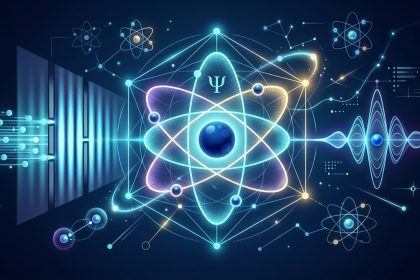
The atom is a basic unit of matter consisting of a dense, central nucleus surrounded by a cloud of negatively charged electrons. The atomic nucleus contains a mix of positively charged protons and electrically neutral neutrons (except in the case of hydrogen-1, which is the only stable nuclide with no neutron). The electrons of an atom are bound to the nucleus by the electromagnetic force. Likewise, a group of atoms can remain bound to each other, forming a molecule. An atom containing an equal number of protons and electrons is electrically neutral, otherwise it has a positive or negative charge and is an ion. An atom is classified according to the number of protons and neutrons in its nucleus: the number of protons determines the chemical element, and the number of neutrons determine the isotope of the element.[1]
Additional info
Ångström
The ångström or angstrom (symbol Å) (pronounced /ˈɔːŋstrəm/; Swedish: IPA: [ˈɔŋstrˈøm]) is an internationally recognized unit of length equal to 0.1 nanometre or 1 × 10⁻¹⁰ metres. It is named after Anders Jonas Ångström. Although accepted for use, it is not formally defined within the International System of Units (SI).Absolute zero
Absolute zero is the temperature at which entropy reaches its minimum value. As implied by the laws of thermodynamics, absolute zero cannot be reached by artificial or natural means because this would require a system to be fully removed from the rest of the universe. A system at theoretical absolute zero possesses quantum mechanical zero-point energy. While all molecular motion does not cease at absolute zero, the system does not have enough energy for transference to other systems. It is therefore correct to say that molecular energy is minimal at absolute zero.Absorption band
An absorption band is a range of wavelengths (or, equivalently, frequencies) in the electromagnetic spectrum which are able to excite a particular transition in a substance. See absorption spectrum. Since energetic transitions can take place in both directions, many absorption bands can also act as an emission band.Acta Crystallographica
Acta Crystallographica refers to a family of scientific journals, with peer-reviewed articles about crystallography, published by the International Union of Crystallography. The journal was begun in 1948 as a single journal called Acta Crystallographica.[1]Adsorb
Adsorption is the adhesion of molecules of gas, liquid, or dissolved solids to a surface.[1] This process creates a film of the adsorbate (the molecules or atoms being accumulated) on the surface of the adsorbent. It differs from absorption, in which a fluid permeates or is dissolved by a liquid or solid.[2] The term sorption encompasses both processes, while desorption is the reverse of adsorption.Age of the Earth
Modern geologists and geophysicists accept that the age of the Earth is around 4.54 billion years (4.54 × 10⁹ years ± 1%).[1][2][3] This age has been determined by radiometric age dating of meteorite material and is consistent with the ages of the oldest-known terrestrial and lunar samples. The Sun, by comparison, is about 4.57 billion years old, about 30 million years older.Albert Einstein
Albert Einstein (pronounced /ˈælbərt ˈaɪnstaɪn/; German: [ˈalbɐt ˈaɪ̯nʃtaɪ̯n] (
listen); 14 March 1879–18 April 1955) was a theoretical physicist who is widely regarded as one of the most influential scientists of all time, and the "greatest physicist ever", according to a 1999 poll of leading physicists[3]. His many contributions to physics include the special and general theories of relativity, the founding of relativistic cosmology, the first post-Newtonian expansion, explaining the perihelion advance of Mercury, prediction of the deflection of light by gravity and gravitational lensing, the first fluctuation dissipation theorem which explained the Brownian movement of molecules, the photon theory and wave-particle duality, the quantum theory of atomic motion in solids, the zero-point energy concept, the semiclassical version of the Schrödinger equation, and the quantum theory of a monatomic gas which predicted Bose–Einstein condensation.Alpha decay
Alpha decay is a type of radioactive decay in which an atomic nucleus emits an alpha particle, and thereby transforms (or 'decays') into an atom with a mass number 4 less and atomic number 2 less. For example:American Journal of Physics
The American Journal of Physics is a peer-reviewed scientific journal published by the American Association of Physics Teachers devoted to the educational and cultural aspects of physics. It is notable for its entertaining and accessible style.Angular momentum
Angular momentum is a vector quantity that is useful in describing the rotational state of a physical system. The angular momentum L of a particle with respect to some point of origin is aAntihydrogen
Antihydrogen is the antimatter counterpart of hydrogen. Whereas the common hydrogen atom is composed of an electron and proton, the antihydrogen atom is made up of a positron and antiproton. Its (proposed) chemical symbol is H, that is, H with an overbar (pronounced /ˌeɪtʃ ˈbɑr/ aitch-bar).Antimatter
In particle physics, antimatter is the extension of the concept of the antiparticle to matter, where antimatter is composed of antiparticles in the same way that normal matter is composed of particles. For example, an antielectron (a positron, an electron with a positive charge) and an antiproton (a proton with a negative charge) could form an antihydrogen atom in the same way that an electron and a proton form a normal matter hydrogen atom. Furthermore, mixing matter and antimatter would lead to the annihilation of both in the same way that mixing antiparticles and particles does, thus giving rise to high-energy photons (gamma rays) or other particle–antiparticle pairs.Antineutrino
In physics, antineutrinos are the antiparticles of neutrinos, which are neutral particles produced in nuclear beta decay. These are emitted in beta particle emissions, where a neutron turns into a proton. They have a spin of 1/2, and they are part of the lepton family of particles. The antineutrinos observed so far all have right-handed helicity (i.e., only one of the two possible spin states has ever been seen), while the neutrinos are left-handed. Antineutrinos interact with other matter only through the gravitational and weak forces, making them very difficult to detect experimentally. Neutrino oscillation experiments indicate that antineutrinos have mass, but beta decay experiments constrain that mass to be very small.Antoine Lavoisier
Antoine-Laurent de Lavoisier (26 August 1743 – 8 May 1794); French pronunciation: [ɑ̃ˈtwan lɔˈʁɑ̃ də la.vwaˈzje]), the father of modern chemistry,[1] was a French noble prominent in the histories of chemistry and biology. He stated the first version of the law of conservation of mass,[2] recognized and named oxygen (1778) and hydrogen (1783), abolished the phlogiston theory, helped construct the metric system, wrote the first extensive list of elements, and helped to reform chemical nomenclature. He discovered that, although matter may change its form or shape, its mass always remains the same. Thus, for instance, if water is heated to steam, if salt is dissolved in water or if a piece of wood is burned to ashes, the total mass remains unchanged. He was also an investor and administrator of the "Ferme Générale" a private tax collection company; chairman of the board of the Discount Bank (later the Banque de France); and a powerful member of a number of other aristocratic administrative councils. All of these political and economic activities enabled him to fund his scientific research. At the height of the French Revolution he was accused by Marat of selling watered-down tobacco, and of other crimes, and was beheaded.[3][4]Argon
Argon (pronounced /ˈɑrɡɒn/) is a chemical element designated by the symbol Ar. Argon has atomic number 18 and is the third element in group 18 of the periodic table (noble gases). Argon is the third most common gas in the Earth's atmosphere, at 0.93% -- making it more common than carbon dioxide. It is the third most abundant gas and the most frequently used of the noble gases. Argon's full outer shell makes it stable and resistant to bonding with other elements. Its triple point temperature of 83.8058 K is a defining fixed point in the International Temperature Scale of 1990.Asymptotic giant branch
The asymptotic giant branch is the region of the Hertzsprung-Russell diagram populated by evolving low to medium-mass stars. This is a period of stellar evolution undertaken by all low to intermediate mass stars (0.6–10 solar masses) late in their life.Atom probe
The atom probe is an atomic-resolution microscope used in materials science that was invented in 1967 by Erwin Wilhelm Müller, J. A. Panitz, and S. Brooks McLane.[1]Atomic mass
The atomic mass (ma) is the mass of an atom, most often expressed in unified atomic mass units.[1] The atomic mass may be considered to be the total mass of protons and neutrons (not including electrons) in a single atom (when the atom is motionless). The atomic mass is sometimes incorrectly used as a synonym of relative atomic mass, average atomic mass and atomic weight; these differ subtly from the atomic mass. The atomic mass is defined as the mass of an atom, which can only be one isotope at a time and is not an abundance-weighted average. In the case of many elements that have one dominant isotope the actual numerical similarity/difference between the atomic mass of the most common isotope and the relative atomic mass or standard atomic weights can be very small such that it does not affect most bulk calculations-- but such an error can be critical when considering individual atoms. For elements with more than one common isotope the difference even to the most common atomic mass can be half a mass unit or more (e.g. chlorine). The atomic mass of an uncommon isotope can differ from the relative atomic mass or standard atomic weight by several mass units.Atomic mass unit
The unified atomic mass unit or atomic mass unit (u), or dalton (Da) or, sometimes, universal mass unit (u), is a unit of mass used to express atomic and molecular masses. It is the approximate mass of a hydrogen atom, a proton, or a neutron.Atomic mirror
In physics, an atomic mirror is a device which reflects neutral atoms in the similar way as the conventional mirror reflects visible light. Atomic mirrors can be made of electric fields or magnetic fields,[1] electromagnetic waves [2] or just silicon wafer; in the last case, atoms are reflected by the attracting tails of the van der Waals attraction (see quantum reflection).[3][4][5] Such reflection is efficient when the normal component of the wavenumber of the atoms is small or comparable to the effective depth of the attraction potential (roughly, the distance at which the potential becomes comparable to the kinetic energy of the atom). To reduce the normal component, most atomic mirrors are blazed at the grazing incidence.Atomic nucleus
The nucleus is the very dense region consisting of nucleons (protons and neutrons) at the center of an atom. Almost all of the mass in an atom is made up from the protons and neutrons in the nucleus, with a very small contribution from the orbiting electrons.Atomic number
In chemistry and physics, the atomic number (also known as the proton number) is the number of protons found in the nucleus of an atom and therefore identical to the charge number of the nucleus. It is conventionally represented by the symbol Z. The atomic number uniquely identifies a chemical element. In an atom of neutral charge, the atomic number is also equal to the number of electrons.Atomic orbital
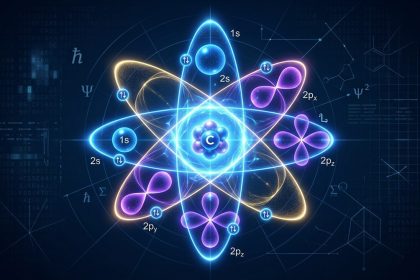
An atomic orbital is a mathematical function that describes the wave-like behavior of either one electron or a pair of electrons, in an atom.[1] This function can be used to calculate the probability of finding any electron of an atom in any specific region around the atom's nucleus. These functions may serve as three-dimensional graph of an electron’s likely location. The term may thus refer directly to the physical region defined by the function where the electron is likely to be.[2] Specifically, atomic orbitals are the possible quantum states of an individual electron in the collection of electrons around a single atom, as described by the orbital function.Atomic radius
The atomic radius of a chemical element is a measure of the size of its atoms, usually the mean or typical distance from the nucleus to the boundary of the surrounding cloud of electrons. Since the boundary is not a well-defined physical entity, there are various non-equivalent definitions of atomic radius.Atomic theory
In chemistry and physics, atomic theory is a theory of the nature of matter, which states that matter is composed of discrete units called atoms, as opposed to the obsolete notion that matter could be divided into any arbitrarily small quantity. It began as a philosophical concept in ancient Greece and India and entered the scientific mainstream in the early 19th century when discoveries in the field of chemistry showed that matter did indeed behave as if it were made up of particles.Atomism
Atomism is a natural philosophy developed by Leucippus and his student Democritus in the fifth century BC[1]. These atomists theorized that the natural world consists of two fundamental and opposite, indivisible bodies – atoms and void (void is mere nothing, or the body's negation). Atoms are intrinsically unchangeable and move about the void combining into different clusters (and these clusters form deferring substances)[1]. Atoms are reality's very small, indestructible building blocks (Aristotle, Metaphysics, I, 4, 985 b, 10–15). The word atomism derives from the ancient Greek adjective atomos, which literally meant 'uncuttable' (a - tomos (not cuttable) – tomos a conjugate of the Greek verb temnein (to cut)).Avogadro constant
The Avogadro constant (symbols: L, NA) is the number of "elementary entities" (usually atoms or molecules) in one mole, that is (from the definition of the mole), the number of atoms in exactly 12 grams of carbon-12.[2][3] It was originally called Avogadro's number. The 2006 CODATA recommended value is[1]:Axino
The axino is a hypothetical elementary particle predicted by some theories of particle physics. Peccei-Quinn theory attempts to explain the observed phenomenon known as the strong CP problem by introducing a hypothetical real scalar particle called the axion. Adding supersymmetry to the model predicts the existence of a fermionic superpartner for the axion, the axino and a bosonic superpartner the saxion. They are all bundled up in a chiral superfield.Axion
The axion is a hypothetical elementary particle postulated by the Peccei-Quinn theory in 1977 to resolve the strong-CP problem in quantum chromodynamics (QCD). Some spurious results in 2005 appeared to confirm their existence; those results were later deprecated.BCE
Common Era, abbreviated as CE, is one name used for the most widespread calendrical year numbering system.[1][2] There are many names in many languages for the same year numbering scheme. The numbering of years using Common Era notation is identical to the numbering used with Anno Domini (BC/AD) notation, 2010 being the current year in both notations and neither using a year zero.[3] Common Era is also known as Christian Era[4] and Current Era,[5] with all three expressions abbreviated as CE.[6] (Christian Era is, however, also abbreviated AD, for Anno Domini.[7]) Dates before the year 1 CE are indicated by the usage of BCE, short for "Before the Common Era", "Before the Christian Era", or "Before the Current Era".[8] Both the BCE/CE and BC/AD notations are based on a sixth-century estimate for the year in which Jesus was conceived or born, with the common era designation originating among Christians in Europe at least as early as 1615 (at first in Latin).[9]B meson
B mesons are mesons composed of a bottom antiquark and either an up (B+), down (B0), strange (B0s) or charm quark (B+c). The combination of a bottom antiquark and a top quark is not thought to be possible because of the top quark's short lifetime. The combination of a bottom antiquark and a bottom quark is not a B meson, but rather bottomonium.Barium
Barium (pronounced /ˈbɛəriəm/, BAIR-ee-əm) is a chemical element. It has the symbol Ba, atomic number 56, and is the fifth element in Group 2. Barium is a soft silvery metallic alkaline earth metal. It is never found in nature in its pure form due to its reactivity with air. Its oxide is historically known as baryta but it reacts with water and carbon dioxide and is not found as a mineral. The most common naturally occurring minerals are the very insoluble barium sulfate, BaSO4 (barite), and barium carbonate, BaCO3 (witherite). Barium's name originates from Greek barys (βαρύς), meaning "heavy", describing the high density of some common barium-containing ores.Baryogenesis
In physical cosmology, baryogenesis is the generic term for hypothetical physical processes that produced an asymmetry between baryons and antibaryons in the very early universe, resulting in the substantial amounts of residual matter that make up the universe today.Baryon
Baryons are the family of composite particles made of three quarks, as opposed to the mesons which are the family of composite particles made of one quark and one antiquark. Both baryons and mesons are part of the larger particle family comprising all particles made of quarks—the hadrons. The term baryon is derived from the Greek βαρύς (barys), meaning "heavy", because at the time of their naming it was believed that baryons were characterized by having greater masses than other particles.Bell Labs
Bell Laboratories (also known as Bell Labs and formerly known as AT&T Bell Laboratories and Bell Telephone Laboratories) is the research and development organization of Alcatel-Lucent and previously of the American Telephone & Telegraph Company (AT&T).Beta decay
In nuclear physics, beta decay is a type of radioactive decay in which a beta particle (an electron or a positron) is emitted. In the case of electron emission, it is referred to as beta minus (β−), while in the case of a positron emission as beta plus (β+). Kinetic energy of beta particles has continuous spectrum ranging from 0 to maximal available energy (Q), which depends on parent and daughter nuclear states participating in the decay. Typical Q is around 1 MeV, but it can range from a few keV to a few tens of MeV. The most energetic beta particles are ultrarelativistic, with speeds very close to the speed of light.Beta particle
Beta particles are high-energy, high-speed electrons or positrons emitted by certain types of radioactive nuclei such as potassium-40. The beta particles emitted are a form of ionizing radiation also known as beta rays. The production of beta particles is termed beta decay. They are designated by the Greek letter beta (β). There are two forms of beta decay, β− and β+, which respectively give rise to the electron and the positron.Bibcode
The bibcode is an identifier used by a number of astronomical data systems to specify literature references. The bibcode was developed to be used in SIMBAD and the NASA/IPAC Extragalactic Database (NED), but is now used more widely, for example, in the NASA Astrophysics Data System.[1][2] The code has a fixed length of 19 characters and has the formBig Bang
The Big Bang is the cosmological model of the initial conditions and subsequent development of the Universe that is supported by the most comprehensive and accurate explanations from current scientific evidence and observation.[1][2] As used by cosmologists, the term Big Bang generally refers to the idea that the Universe has expanded from a primordial hot and dense initial condition at some finite time in the past (best available measurements in 2009 suggest that the initial conditions occurred around 13.3 to 13.9 billion years ago[3][4]), and continues to expand to this day.Big Bang nucleosynthesis
In physical cosmology, Big Bang nucleosynthesis (or primordial nucleosynthesis, abbreviated BBN) refers to the production of nuclei other than those of H-1 (i.e. the normal, light isotope of hydrogen, whose nuclei consist of a single proton each) during the early phases of the universe. Primordial nucleosynthesis took place just a few minutes after the Big Bang and is believed to be responsible for the formation of a heavier isotope of hydrogen known as deuterium (H-2 or D), the helium isotopes He-3 and He-4, and the lithium isotopes Li-6 and Li-7. In addition to these stable nuclei some unstable, or radioactive, isotopes were also produced during primordial nucleosynthesis: tritium or H-3; beryllium-7 (Be-7), and beryllium-8 (Be-8). These unstable isotopes either decayed or fused with other nuclei to make one of the stable isotopes.Binding energy
Binding energy is the mechanical energy required to disassemble a whole into separate parts. A bound system has typically a lower potential energy than its constituent parts; this is what keeps the system together. The usual convention is that this corresponds to a positive binding energy.Biocoenosis
A biocoenosis (alternatively, biocoenose or biocenose ), termed by Karl Möbius in 1877, describes all the interacting organisms living together in a specific habitat (or biotope). Biotic community , biological community, and ecological community are more common synonyms of biocenosis, all of which represent the same concepts. Three related descriptors are zoocoenosis for the faunal community, phytocoenosis for the floral community and microbiocoenosis for the microbial community within an ecosystem.[1] The extent or geographical area of a biocenose is limited only by the requirement of a more or less uniform species composition.Biological organisation
Biological organisation, or the hierarchy of life, is the hierarchy of complex biological structures and systems that define life using a reductionistic approach.[1] The traditional hierarchy, as detailed below, extends from atoms (or lower) to biospheres. The higher levels of this scheme are often referred to as ecological organisation.Biological system
In biology, a Biological system (or Organ system) is a group of organs that work together to perform a certain task. Common systems, such as those present in mammals and other animals, seen in human anatomy, are those such as the circulatory system, the respiratory system, the nervous system, etc.Biomolecule
A biomolecule is any organic molecule that is produced by a living organism, including large polymeric molecules such as proteins, polysaccharides, and nucleic acids as well as small molecules such as primary metabolites, secondary metabolites, and natural products.Biosphere
The biosphere is the global sum of all ecosystems. It can also be called the zone of life on Earth. From the broadest biophysiological point of view, the biosphere is the global ecological system integrating all living beings and their relationships, including their interaction with the elements of the lithosphere, hydrosphere, and atmosphere. The biosphere is postulated to have evolved, beginning through a process of biogenesis or biopoesis, at least some 3.5 billion years ago.[1]Bismuth
Bismuth (pronounced /ˈbɪzməθ/, BIZ-məth) is a chemical element that has the symbol Bi and atomic number 83. This trivalent poor metal chemically resembles arsenic and antimony. Bismuth is heavy and brittle; it has a silvery white color with a pink tinge owing to the surface oxide. Bismuth is the most naturally diamagnetic of all metals, and only mercury has a lower thermal conductivity. It is generally considered to be the last naturally occurring stable, non-radioactive element on the periodic table, although it is actually slightly radioactive, with an extremely long half-life.Bohr model
In atomic physics, the Bohr model, devised by Niels Bohr, depicts the atom as a small, positively charged nucleus surrounded by electrons that travel in circular orbits around the nucleus—similar in structure to the solar system, but with electrostatic forces providing attraction, rather than gravity. This was an improvement on the earlier cubic model (1902), the plum-pudding model (1904), the Saturnian model (1904), and the Rutherford model (1911). Since the Bohr model is a quantum physics-based modification of the Rutherford model, many sources combine the two, referring to the Rutherford–Bohr model.Boron
Boron (pronounced /ˈbɔrɒn/) is the chemical element with atomic number 5 and the chemical symbol B. Boron is a trivalent metalloid element which occurs abundantly in the evaporite ores borax and ulexite.Bose–Einstein condensate
A Bose–Einstein condensate (BEC) is a state of matter of a dilute gas of weakly interacting bosons confined in an external potential and cooled to temperatures very near to absolute zero (0 K, −273.15 °C, or −459.67 °F). Under such conditions, a large fraction of the bosons occupy the lowest quantum state of the external potential, and all wave functions overlap each other, at which point quantum effects become apparent on a macroscopic scale.Bose-Einstein condensation
A Bose–Einstein condensate (BEC) is a state of matter of a dilute gas of weakly interacting bosons confined in an external potential and cooled to temperatures very near to absolute zero (0 K, −273.15 °C, or −459.67 °F). Under such conditions, a large fraction of the bosons occupy the lowest quantum state of the external potential, and all wave functions overlap each other, at which point quantum effects become apparent on a macroscopic scale.Boson
In particle physics, bosons are subatomic particles which obey Bose–Einstein statistics; they are named after Satyendra Nath Bose and Albert Einstein. In contrast to fermions, which obey Fermi-Dirac statistics, several bosons can occupy the same quantum state. Thus, bosons with the same energy can occupy the same place in space. Therefore bosons are often force carrier particles while fermions are usually associated with matter, though in quantum physics the distinction between the two concepts is not clear cut.Botany
Botany, plant science(s), phytology, or plant biology is a branch of biology and is the scientific study of plant life and development. Botany covers a wide range of scientific disciplines that study plants, algae, and fungi including: structure, growth, reproduction, metabolism, development, diseases, chemical properties, and evolutionary relationships between the different groups. Botany began with tribal efforts to identify edible, medicinal and poisonous plants, making botany one of the oldest sciences. From this ancient interest in plants, the scope of botany has increased to include the study of over 550,000 species of living organisms.Bound state
In physics, a bound state is a composite (of two or more building blocks (particles or bodies)) that behaves as a single object. In quantum mechanics (where the number of particles is conserved), a bound state is a state in the Hilbert space that corresponds to two or more particles whose interaction energy is negative, and therefore these particles cannot be separated unless energy is spent. The energy spectrum of a bound state is discrete, unlike the continuous spectrum of isolated particles. (Actually, it is possible to have unstable bound states with a positive interaction energy provided that there is an "energy barrier" that has to be tunnelled through in order to decay. This is true for some radioactive nuclei and for some electret materials able to carry electric charge for rather long periods.)Brownian motion
Brownian motion (named after the Scottish botanist Robert Brown) is the seemingly random movement of particles suspended in a fluid (i.e. a liquid or gas) or the mathematical model used to describe such random movements, often called a particle theory.