Applied physics

Related:
2MASS, 2dF Galaxy Redshift Survey, Accelerator physics, Acoustics, Agrophysics, Albert Einstein, Analog Electronics, Applied mathematics, Applied physics (disambiguation), Argon, Astrophysics, Atomic, molecular, and optical physics, Atomic force microscope, BOOMERanG experiment, Ballistics, Bell test experiments, Biophysics, Cavendish experiment, Classical mechanics, Communication Physics, Computational physics, Condensed matter physics, Control Theory, Cosmic Background Explorer (COBE), Davisson-Germer experiment, Department of Applied Physics, University of Calcutta, Digital Electronics, Double slit experiment, Econophysics, Electromagnetism, Engineering, Engineering physics, Ernest Rutherford, Erwin Schrödinger, Eugene Wigner, Fiber Optics, Fluid dynamics, Foucault pendulum, Franck Hertz experiment, Galileo Galilei, Geiger–Marsden experiment, Geophysics, Gravity Probe A, Gravity Probe B, Hadron Elektron Ring Anlage, History of physics, Homestake Experiment, Imaging, Isaac Newton, James Clerk Maxwell, James Webb Space Telescope, Large Hadron Collider, Laser, MRI, Mass–energy equivalence, Medical physics, Metrology, Michelson-Morley experiment, Microfluidics, Nanotechnology, Neutrino experiment, Niels Bohr, Nondestructive testing, Nuclear engineering, Nuclear technology, Oil-drop experiment, Optics, Optoelectronics, Particle Physics, Paul Dirac, Photovoltaics, Physics, Plasma physics, Quantum electronics, Quantum mechanics, Relativistic Heavy Ion Collider, Richard Feynman, Semiconductor, Sloan Digital Sky Survey, Soil Physics, Solid state physics, Space Shuttle, Space physics, Spintronics, Statistical mechanics, Stern-Gerlach experiment, Superconductor, Theory of relativity, Thermodynamics, Vehicle dynamics, Werner Heisenberg, Wilkinson Microwave Anisotropy Probe, Wolfgang Pauli,

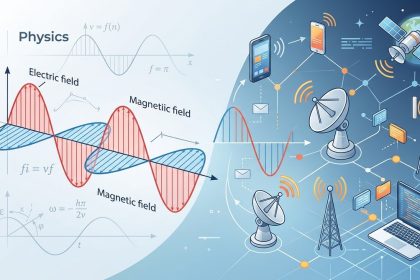
Applied physics is a general term for physics which is intended for a particular technological or practical use. "Applied" is distinguished from "pure" by a subtle combination of factors such as the motivation and attitude of researchers and the nature of the relationship to the technology or science that may be affected by the work.[1] It usually differs from engineering in that an applied physicist may not be designing something in particular, but rather is using physics or conducting physics research with the aim of developing new technologies or solving an engineering problem. This approach is similar to that of applied mathematics. In other words, applied physics is rooted in the fundamental truths and basic concepts of the physical sciences but is concerned with the utilization of these scientific principles in practical devices and systems. Applied physicists can also be interested in the use of physics for scientific research. For instance, people working on accelerator physics seek to build better accelerators for research in theoretical physics.

Additional info
2MASS
Observations for the Two Micron All-Sky Survey (2MASS)[1] began in 1997 and were completed in 2001 at two telescopes located one each in the northern and southern hemispheres (Mt. Hopkins Arizona and Cerro Tololo/CTIO Chile, respectively) to ensure coverage of the entire sky. The most ambitious project to map the night sky to date, the final (post-processing) data release for 2MASS occurred in 2003. The whole sky was covered using photometric system of three infrared wavebands around 2 micrometres (μm): J (1.25 μm), H (1.65 μm), and Ks (2.17 μm).
2dF Galaxy Redshift Survey
In astronomy, the 2dF Galaxy Redshift Survey (Two-degree-Field Galaxy Redshift Survey), 2dF or 2dFGRS is a redshift survey conducted by the Anglo-Australian Observatory (AAO) with the 3.9m Anglo-Australian Telescope between 1997 and 11 April 2002.[1] The data from this survey were made public on 30 June 2003. The survey determined the large-scale structure in one section of the local Universe. As of July 2009, it is the second largest redshift survey next to the Sloan Digital Sky Survey which began in 2000. Matthew Colless, Steve Maddox and John Peacock were in charge of the project.
Acoustics
Acoustics is the interdisciplinary science that deals with the study of sound, ultrasound and infrasound (all mechanical waves in gases, liquids, and solids). A scientist who works in the field of acoustics is an acoustician. The application of acoustics in technology is called acoustical engineering. There is often much overlap and interaction between the interests of acousticians and acoustical engineers.
Agrophysics
Agrophysics is a branch of science bordering on physics and agronomy, whose objects of study are the agroecosystem and the biological objects affected by human activity, studied and described using the methods of physical sciences.
       Page is a mirror of - Applied physics from Wikipedia (licence GFDL, CC-BY-SA 3.0, authors, history, edit this page)